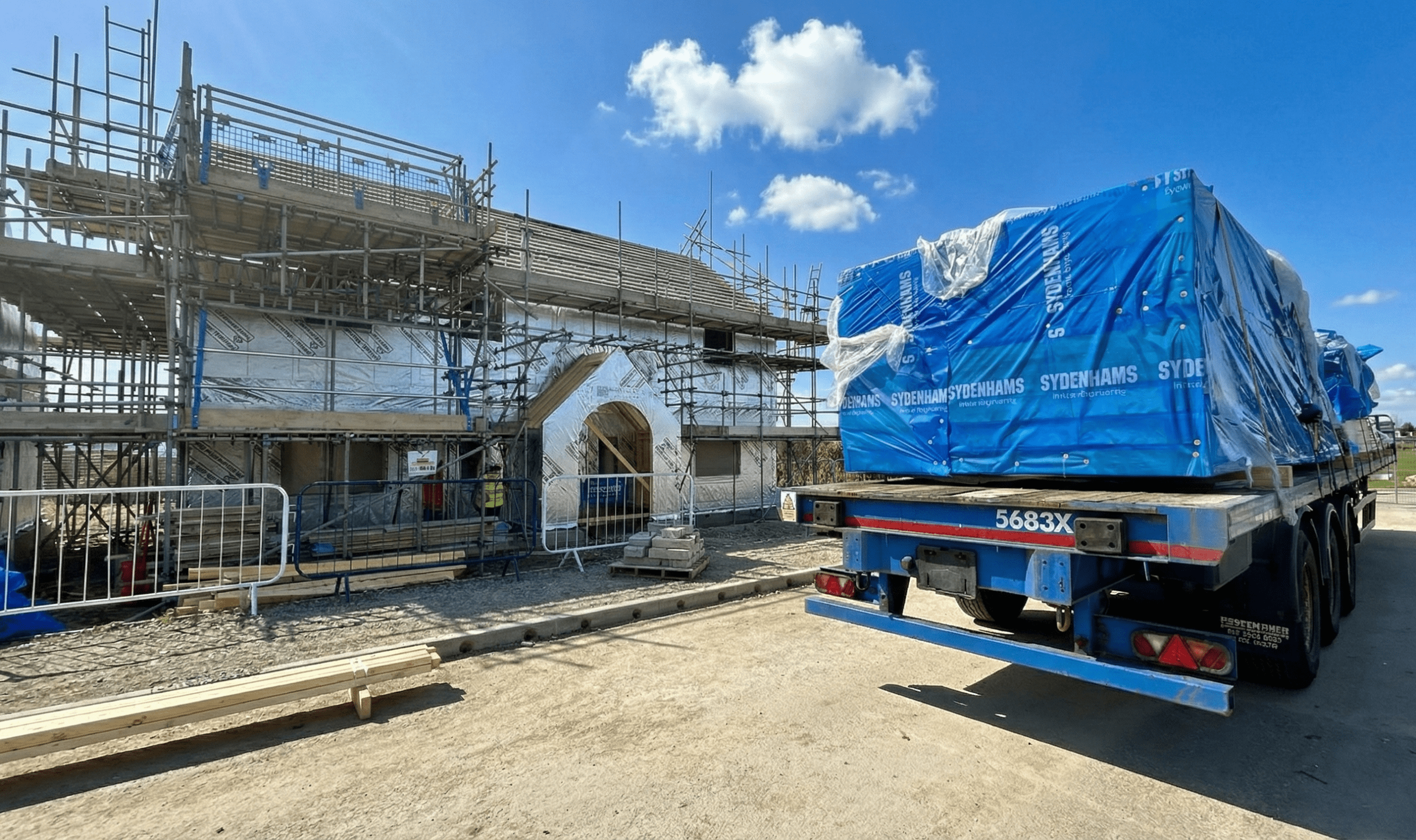

Bridge House was designed with one clear objective: reduce environmental impact at every stage, from construction through to long-term operation. Rather than layering technology onto a conventional build, the project began with a fabric-first strategy and low carbon construction principles.
The result is a home that generates more renewable energy annually than it consumes. If connected to the grid, it exports zero carbon electricity. Operationally, it achieves net zero carbon from the outset.
Fabric First Design
Energy demand was reduced before renewable systems were considered. The design focused on low U-values, a continuous thermal envelope and careful control of air leakage to ensure that performance on paper translates into real-world efficiency.
The Bio Twin Wall system forms the backbone of the external envelope, delivering high thermal performance and structural integrity.

Key building fabric performance includes:
- External Walls – Bio Twin Wall system, U-value 0.12 W/m²K
- Ground Floor – Suspended timber floor with metal web joists, U-value 0.12 W/m²K
- Ground Floor Ring Beam – Laminated timber beams
- Roof – Vaulted cut roof, U-value 0.16 W/m²K beneath thatch and 0.12 W/m²K in timber areas
- Fire Rating – REI60 from inside to out
- Predicted Design Life – 60+ years
- Sequestered Carbon within timber frame – approximately 72 tonnes CO₂e
Insulation was supplied and installed using Actis Hybris across the ground floor, walls and roof. Airtightness was supported through ACL membranes, taped junctions and airtight flooring systems from Medite Smartply.
The entire scheme was modelled in Autodesk Revit, enabling detailed coordination, structural calculations and performance validation at design stage.

Eliminating Fossil Fuels
Bridge House operates without fossil fuels. Energy demand is met through a 10 kWp photovoltaic system arranged in an agrovoltaic configuration. This allows continued agricultural use of the land while generating clean electricity, preserving biodiversity and productive space simultaneously.
The building services strategy includes:
- Ground source heat pump for heating and cooling
- Underfloor heating distribution
- Mechanical ventilation with heat recovery to reduce heat loss and improve indoor air quality
Together, these systems ensure a net zero operational energy scheme while maintaining year-round comfort.

Addressing Embodied Carbon
Operational performance is only part of the carbon story. Embodied carbon was reduced through material selection and construction methodology.
A key decision was to support the house on screw piles rather than traditional concrete foundations. Eliminating concrete altogether and associated excavation and muck-away. Combined with the carbon sequestered within the timber frame structure, the overall embodied carbon impact of the dwelling was substantially lowered.
Services Delivered by Sydenhams Timber Engineering
Sydenhams Timber Engineering provided an integrated design, manufacture and installation service, including:
- Timber frame superstructure manufacture, supply and installation
- Revit modelling and structural calculations
- Supply and installation of Actis Hybris insulation
- Supply and installation of airtightness membranes and tapes
- Airtight flooring installation at ground floor level
- Service battens to external walls
- Mechanical lifting and cranage
- Energy assessment services including SAP calculations, EPC production under Part L, U-value calculations, PSI value modelling, overheating risk analysis under Part O and airtightness testing
Bridge House demonstrates how a self build can move beyond compliance and become a genuinely regenerative home, combining measurable performance, reduced embodied carbon and long-term durability through the Bio Twin Wall system.